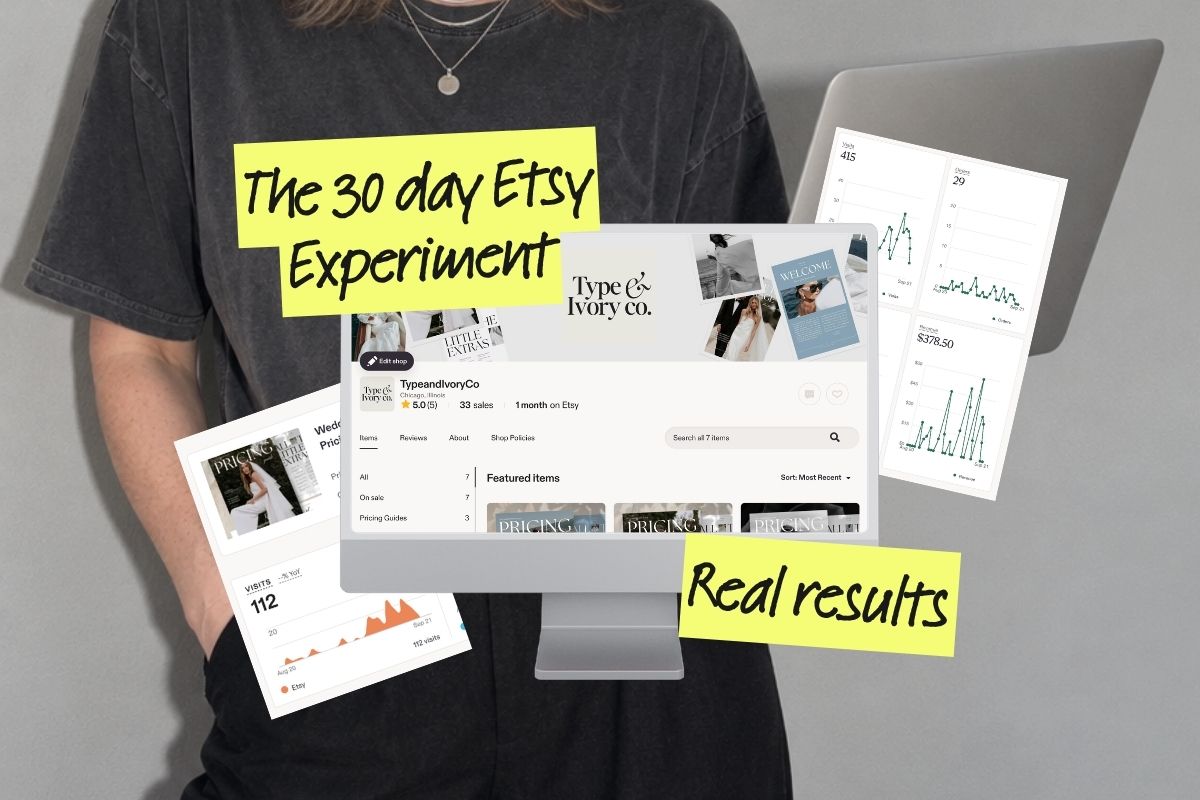
Thirty days ago, I started a brand-new Etsy shop. And I didn’t tell anyone.
I didn’t announce it on Instagram. I didn’t email my list. I didn’t send my existing customers to it. I didn’t even connect it to Superhero Design.
I wanted to know what would happen if I started completely from scratch. Could I create a brand-new digital product business, put a handful of products on Etsy and actually get strangers to buy them?
Do digital products still sell on Etsy in 2026, or is the opportunity completely oversaturated?
So I decided to test it myself. And because I apparently don’t know how to casually test anything 😂, I documented the entire experiment along the way. Here’s exactly what happened.
The rules of my Etsy experiment
I wanted this to be as close to starting from zero as possible. Obviously, I had one major advantage: I’ve been a graphic designer for more than 20 years and have been selling digital products for years.
But I wanted to remove the biggest advantage I already have: an audience. So I created a completely separate brand called Type & Ivory Co. I didn’t tell my Instagram followers about it, promote it to my email list or send existing customers there. The only social platform that sent traffic during the experiment was Pinterest.

My goal wasn’t to see how much money I could make by sending my existing audience somewhere new. I wanted to see if Etsy could actually help a brand-new shop find buyers.
How I chose the niche and first products
I didn’t pick photographers because I personally thought it sounded like a cute niche and then spend weeks designing products. I treated the entire shop like a validation experiment from the beginning.
Before I made anything, I researched what people were already shopping for on Etsy. I looked at existing categories, the types of digital products that kept appearing, how competing listings were positioned, pricing, reviews and the language sellers were using to describe their products.
Several promising product ideas came out of that research, but the numbers weren’t my only consideration. I also asked myself whether I would actually enjoy designing the products. I could have chosen a niche simply because it looked profitable, but I knew I would lose interest quickly if I felt no connection to the work.
One idea that kept popping up was Airbnb welcome guides. The research showed strong demand with relatively little competition, so if that sounds more interesting to you, consider this your little tip. I didn’t test an Airbnb product inside this shop, but the market opportunity itself looked very promising.
The research kept pointing me toward photographers, so I narrowed the shop instead of trying to sell digital templates to everyone. I created editable Canva templates around problems photographers already spend money to solve: pricing guides to present their offers professionally and session guides to prepare clients and communicate their process.

I launched with a small catalog and ended the experiment with just 7 active listings. That was intentional. I wanted real customer data before spending weeks or months building a huge catalog nobody wanted.
The research was the first validation layer. The second was much more important: would anyone actually pay for them?
The actual 30-day timeline
This part is easy to lose when you only look at the final numbers, but the shop didn’t go from zero to 33 sales overnight.
- August 20: Type & Ivory Co. officially launched. I started with a very small catalog and a 75% off introductory sale because the shop had zero sales, zero reviews and zero trust.
- August 24: I made my first sale, just a few days after launch. That was the first real signal that a stranger was willing to pay for one of the products.
- September 3: The shop had reached 12 orders and $111.75 in revenue. At this point I had personally followed up with early buyers and asked for reviews because building trust was part of the experiment too.
- September 5: Etsy finally allowed the new shop to use Etsy Ads. I turned them on with a $10/day budget and advertised every listing except the smallest product. I wanted enough data to learn which listings Etsy could actually turn into buyers.
- September 8: After the original launch sale ended, I started a new 50% off promotion. This gave me another pricing test instead of assuming the original discount was the only reason people were buying.
- September 9: 18 total sales and five reviews.
- September 10: 20 total sales.
- September 11: 23 total sales and $233.50 in revenue.
- September 14: Still 23 sales. Traffic was increasing, but sales had temporarily stalled. This was an important part of the experiment because growth was definitely not a straight line.
- September 21: I closed the 30-day experiment at 33 products sold across 29 orders, $378.50 in revenue and $226.77 in net profit after Etsy fees and marketing.
That timeline is why I don’t think the useful lesson here is simply “I made $378.50 on Etsy.” I was deliberately testing one variable after another: niche, product type, SEO, introductory pricing, reviews, Etsy Ads and then a less aggressive sale.
How I used ChatGPT to build the listings
I also didn’t sit down and magically know what every Etsy title, description and tag should say.
I used ChatGPT to help me turn the market research into actual listings. That included brainstorming SEO-friendly titles, tightening descriptions, generating tag options within Etsy’s character limits, keeping the wording consistent across related products and helping me think through which search phrases a photographer might actually use.
Then I treated those listings as tests too. The point wasn’t to have AI write something once and assume it was perfect. The point was to get a strong, search-aware listing live quickly, see what Etsy and shoppers did with it, and use the results to decide what deserved more attention.
That workflow is a big reason I was able to move quickly. AI didn’t replace the strategy, design or market research. It helped me compress the time between idea, listing and real-world feedback.
The listing presentation was part of the experiment too
I didn’t only test what products to sell. I also made deliberate decisions about how the products were presented inside Etsy.
One of those decisions was to use portrait-oriented listing mockups instead of relying on wide or square graphics. I wanted the product images to take up more visual space and make the templates easy to understand while someone was scrolling through Etsy.
I kept the presentation polished and consistent across the shop so the listings felt like they belonged to an established brand, even though the shop itself was brand new.
I also added a listing video to every product. Because these were editable digital templates, the video gave shoppers another way to see what they were actually getting instead of relying only on static mockups.
Could I tell you that portrait mockups or listing videos were individually responsible for a specific number of sales? No. I didn’t isolate those variables in an A/B test. But they were intentional parts of the listing strategy I used throughout the 30-day experiment, and if I were starting another digital product shop, I would use both again.
I priced the products very aggressively
I launched with a huge introductory discount. Initially, the products were 75% off. After that sale ended, I switched the shop to 50% off.
The $378.50 in revenue I’m about to show you does not represent what these products would have generated at their normal listed prices. The regular-price value of the 33 products I sold was about $985.
I intentionally traded revenue for something I thought was more important during the first month: getting a brand-new shop its first customers, sales history and reviews.
So… what happened after 30 days?
- 7 active listings
- 415 visits
- 29 orders
- 33 products sold
- 7% conversion rate
- $378.50 in sales
- $226.77 net profit after Etsy fees and marketing

Is $226.77 going to change my life? Obviously not. 😂 But honestly, the money ended up being one of the least interesting things about this experiment.
What I really wanted to know was whether complete strangers would find products from a shop they’d never heard of and buy them. And they did. Thirty-three times.
The product that took the lead surprised me
I ended the 30 days with seven active listings, but they absolutely did not perform equally. The Family Session Guide took the lead with 11 sales, while my Wedding Photographer Pricing Guide sold 7 times.
That honestly surprised me. I expected the Wedding Photographer Pricing Guide to outperform a family session guide, but the customers told me otherwise. This is exactly why it is so important to run real tests instead of assuming you already know which product people will want most.
Those two products alone accounted for 18 of the 33 products sold, or about 55% of everything I sold.


This is exactly why I’m glad I didn’t spend three months creating a giant shop before launching. The customers told me very quickly where the demand was.
Etsy is a really useful testing ground
One of my biggest takeaways is that Etsy can be an incredibly useful place to validate a digital product before building an entire business around it.
Etsy already has shoppers. That meant I could put seven products in front of people who had no idea who I was and let their behavior tell me what they actually wanted.
Within 30 days, I knew that two products were responsible for about 55% of everything I sold. I didn’t have to survey my audience, guess which idea was strongest or spend three months creating 50 products. The market told me.
You don’t necessarily have to build your entire business on Etsy. You can use Etsy as a testing ground to find out which ideas have demand, then take what you learn and decide what deserves more of your time, marketing and product development.
For me, that may actually be the most valuable result of this entire experiment.
Traffic was a bigger challenge than conversion
The Family Session Guide generated 11 sales from only 105 visits. My biggest problem wasn’t necessarily convincing people to buy once they found the right product. It was getting enough qualified people to see the products in the first place.
The overall shop conversion rate supports that too. My conversion rate after 30 days was 7%, and earlier in the experiment Etsy was showing conversion rates above 10%.
Etsy Ads made a much bigger difference than I expected
On September 5, I was able to turn Etsy Ads on. I set the budget to $10 per day and advertised almost all of my listings.
By the end of the experiment, my Etsy Ads dashboard showed 7,137 ad impressions, 166 clicks, 14 ad-attributed orders, $237.50 in ad-attributed revenue and $101.81 in ad spend, for a 2.33x ROAS.
About half of my orders were attributed to Etsy Ads. So it would be misleading to pretend I simply uploaded Canva templates and Etsy organically sent me 33 sales.
But Etsy also generated organic discovery through Etsy Search, the Etsy app and pages, and Etsy marketing and SEO. Remember, I wasn’t promoting this shop to my existing audience. Pinterest was the only social source, and it accounted for just 15 visits.
What did Etsy actually cost me?
Revenue is not profit. My total revenue during the experiment was $378.50. After Etsy fees and marketing expenses, Etsy reported $226.77 in net profit. That’s about 60% of revenue remaining after Etsy fees and marketing.
These are digital products, so there’s no inventory to buy, nothing to manufacture and nothing to ship every time an order comes through. But that doesn’t mean the first month was passive. I researched the niche, designed products, created mockups, wrote listings, worked on SEO, monitored the shop and experimented with pricing and ads.
The reviews mattered too
A brand-new shop starts with zero social proof. By the end of the experiment, Type & Ivory Co. had five reviews and a 5.0-star average.

Was the experiment actually successful?
If the goal was “make a ton of money in 30 days,” no. $226.77 in net profit isn’t particularly exciting.
But that wasn’t the question I was trying to answer. My question was: Can I create a digital product shop from scratch, give it no existing audience and get complete strangers to buy from it?
For me, the answer was yes. I sold 33 products in 30 days from only seven active listings. More importantly, I now know which products people wanted, which listings converted, how much Etsy Ads mattered and where I’d focus if I wanted to grow the shop from here.
What I would do differently if I started again
I would still launch before building a giant catalog. I’d rather create a small group of strong products, get them in front of actual buyers and let the data tell me what to create next.
I’d be more strategic with Etsy Ads once I had enough data to identify the listings that were converting, and I wouldn’t keep the introductory discounts as aggressive forever.
The first month was about validation and momentum. The next phase would need to be about profitability and growth. Most importantly, I’d stop guessing. That’s really what this experiment gave me: data.
Do I think Etsy digital products are passive income?
Not in the way they’re usually presented on social media. There is research, design, SEO, listing imagery, pricing, advertising and a lot of competition.
But once I created these products, I didn’t have to recreate them every time someone purchased. Thirty-three products were delivered without me manually fulfilling 33 orders.
That’s the part of digital products I’ve always loved: you do the work once and create something that can sell more than once.
The real lesson wasn’t about Etsy
I’ve been selling digital products long before I started this experiment. And if there’s one advantage I had going into it, it wasn’t some secret Etsy hack. It was knowing how to take an idea and turn it into a finished digital product people could actually buy.
Your design skills don’t have to be tied exclusively to client projects. They can become templates, resources, tools, education, digital products and assets that can continue generating revenue after the original work is finished.
Etsy is simply one place those products can live and one place you can validate them.
So… will I keep the Etsy shop?
Yep. I’m curious now. 😂
The first 30 days answered one question: Will anyone buy this stuff? Yes.
The next question is much more interesting: What happens when the shop has more time?
Now it has sales history, reviews, listings with actual conversion data and information about who clicks and buys.
So as of right now, my plan is to let the shop run for at least six months and keep tracking the sales, traffic, conversion rate, ad performance and overall growth along the way.
I want to see what happens once a brand-new shop has time to build more history. Does organic Etsy traffic grow? Do the same products keep selling? What happens when I change pricing or ads? And does the shop eventually start to compound as it collects more sales and reviews?
And yes, I’m going to keep sharing the actual numbers. Even if they’re terrible. 😂
Want to follow the experiment?
If you’re thinking about selling digital products on Etsy, sign up below and I’ll send you the next update instead of making you remember to come back and check this post.
I’ll share what’s selling, what isn’t, what I’m changing, what I’m spending on ads and how much the shop is actually making as I keep this experiment going.
And if this experiment keeps working, I’m planning to turn everything I learn into a training. You’ll be the first to know about that too.

Melissa Lunt is the founder of Superhero Design, a template shop specializing in high-converting Showit website templates for coaches, photographers, and creative entrepreneurs. With over 10 years of experience designing brands and websites, she helps business owners launch beautiful, strategic sites without the designer price tag or tech stress. Melissa is passionate about creating handcrafted templates that don’t just look custom—they actually book clients. When she’s not designing, you’ll find her drinking coffee, spending time with family and exploring the outdoors.
Explore Showit templates and launch resources at superherodesign.co.
Comments +